

Meagan Jennett is a poet, novelist, and current DFA candidate at the University of Glasgow.
She is also the author of You Know Her.
Ernest Hemingway said, when one finds themself stuck they should ‘write one true sentence. Write the truest sentence that you know.’ So, here’s mine: I’ve written a poetry collection, I’m a published novelist… and I’m stuck on how to begin this brief reflection on my day in the Arts/Quantum Incubator.
I’m stuck because I’ve been trying to find the ‘perfect’ words, as if there were such a thing. I should know better; I’m a writer, I traffic in slipperiness. If I came away with anything from my day talking to scientists, it’s that they do too. The difference perhaps, is that to them the fluid nature of language is a burden, while I see it as a boon.
‘A proton isn’t a “particle”,’ the man to my left opined early in the day, ‘not really.’ Later, he would declare that scientists, with their equatic (I just made that word up—see how fun this is?) language, can understand the beauty and interconnectedness of the world better than even the most profound of artworks.
While I disagree with his hypothesis, I think there’s a kernel of something true underneath his frustration: Simply, that arts and science have too long been portrayed as being separate camps, and therefore that our relationship to one another should be adversarial. Maybe the core issue isn’t our understanding, but that we’re speaking different languages. During the course of my day, I found myself not in a room with ‘artists’ and ‘scientists,’ but instead in the company of a group of people who are deeply curious about the world, who have big dreams and aspirations and so so many questions.
“Maybe the core issue isn’t our understanding, but that we’re speaking different languages.”
My favourite part of the day was the impromptu field trip to the quantum labs in the ARC. Around us, machines hummed and whistled. In one lab, long strands of filament glowed rainbow in the dark. Some of the coldest places in the known universe are sitting right there, quietly in the middle of our campus! Small stickers displayed their names: Proteus, Pandora. Even here, in an indisputable core of science, we have stories. Pandora, who unleashed both death and hope; Proteus, primordial sea-child whose name shares a root with ‘proton,’ and whose nature shares something of the indescribable and mysterious qualities of his etymological cousin.
There’s so much more I could write about my day—my head is filled with myths and questions, ghost stories, sunsets, and the colossal vacuum of space. But instead, I’ll leave you with my favourite image from our discussions: a lone proton (an ‘excitement,’ as my tablemate called it) existing somewhere out in space; an excitement dancing with its entangled partner, countless miles away. What a beautiful ghost story, what a haunting romance.
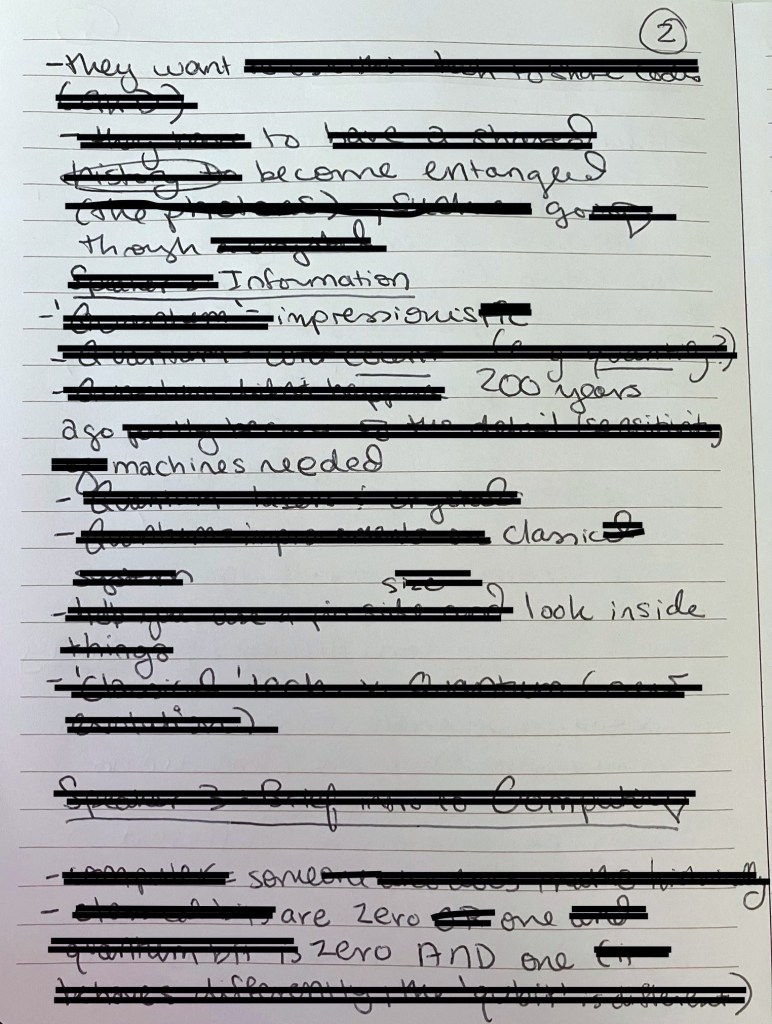
Meagan and Carly created an ‘experiment’ in poetic ‘entanglement’. They sent each other photos of their notes and the other person created an erasure poem, also known as a ‘found poem’, by removing words from the text to reveal a poem underneath.
Meagan’s poem: they want to become entangled, go through information, impressions. 200 years ago, machines needed classics. look inside. some are zero, one, zero AND one.
Read Dr Carly Brown’s blog here.
 Quantum-alliance@glasgow.ac.uk