
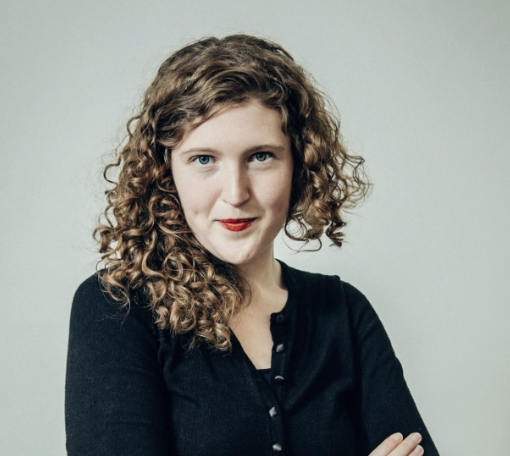
Dr Carly Brown is a poet, author and Lecturer in Creative Writing at the University of Glasgow. She is currently working on a poetry collection about cosmic wormholes.
Perhaps the most memorable part of the day was the speed dating. Two rows of fifteen chairs, artists on one side and physicists on the other. A chance to speak with everyone (with breathless enthusiasm, I noticed, each person increasingly tired and exhilarated by the unique experience). It was during these ‘dates’ I found my mind expanding and contracting the most: each new four-minute conversation calling to mind tiny objects – photons, the smallest sound – and then larger ones – tubes, wires, crystals – and then larger still – satellites, the universe. It was like riding an intellectual merry-go-round, with all the blurry shapes whirring past you. I was uncertain what to picture or if, indeed, to picture anything at all. People spoke of things behind ‘a wall’ (was this wall metaphorical? Literal? Both?). Experiments were like ‘ghost stories’ – you hear tales of them, but when you try to find the same results yourself, they don’t always materialize. Poof. Gone. Like a ghost.
It struck me that it takes a certain courage and a unique generosity on the part of both artists and scientists to meet halfway or, at least, to show up and dance around each other (one artist brought up a possible dance in our discussions). There was also discussion around the limitations of this binary: ‘artist’ and ‘scientist’. I preferred how Ariane Koek referred to us all as ‘experimentalists’, going out into the unknown.
“I preferred how Ariane Koek referred to us all as ‘experimentalists’, going out into the unknown.”
There was a lot of talk of ‘limitations’: of our knowledge, our ability to understand each other and to put complex concepts into words. ‘I don’t know how to explain this…’ I think the physicists might have assumed that, because I work with words, they must do my bidding. But it’s rarely the case. Writers experiment with words, we play, but we sense they are often (always?) inadequate. We know words are like old suitcases – battered, long-travelled, and tired of holding so much. And, as was pointed out, many of the artists there don’t speak primarily with words at all but instead with images, sounds, motions, light.
It’s hard to capture such an event. There was talk of cameras, which themselves have their own biases and limitations, but I’m certainly not a camera. I can’t give a solid, clear image of the day – I’m unable to remember most people’s names, who exactly said what. Much of the science was lost on me, though I did my very best to absorb it. But, as one of the artists offered: ‘I know more than I did at 9 o’clock this morning.’ I thought our visit to the lab upstairs would ‘answer’ some of my questions, but it only brought up more. Each interconnected tube, wire, laser travelling somewhere, connected in ways I couldn’t imagine.
Throughout the day, we kept coming back to the future (and I do intend an allusion there. Scientists – where are our hoverboards? Only kidding!). Earlier in this post, I wrote of words as inadequate, but a few of them stick with me from this day: ‘incubator’ and ‘seed’. These words connote beginnings. New life. Hopefd, I’ll leave you with my favourite image from our discussions: a lone proton (an ‘excitement,’ as my tablemate called it) existing somewhere out in space; an excitement dancing with its entangled partner, countless miles away. What a beautiful ghost story, what a haunting romance.
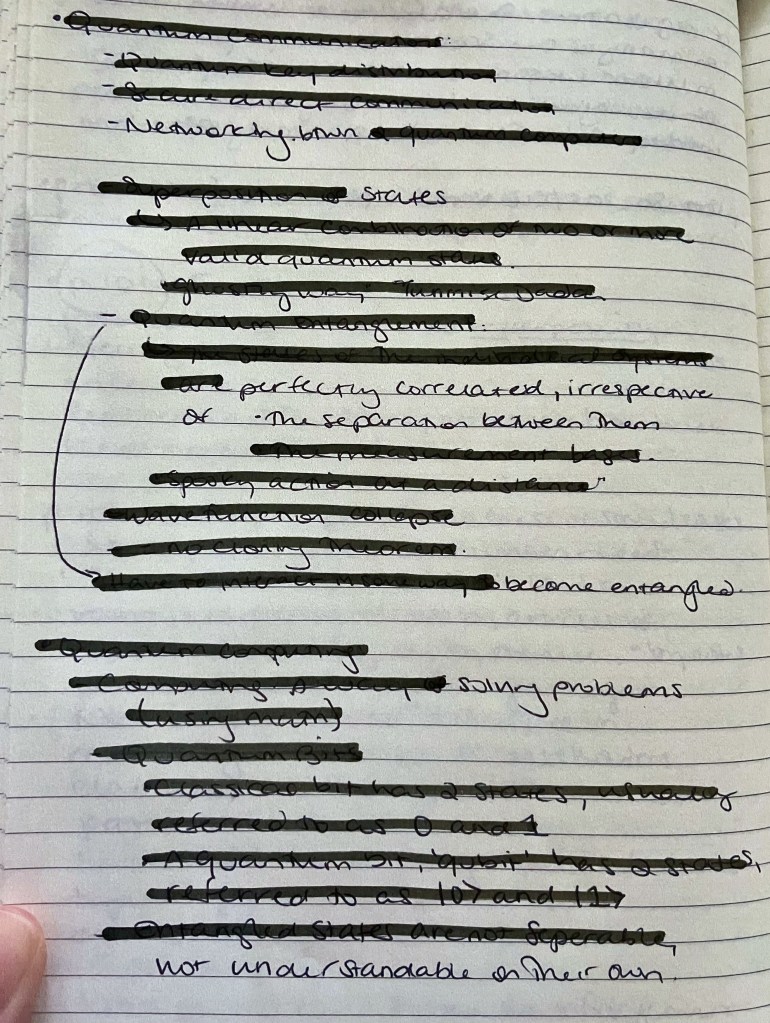
Meagan and Carly created an ‘experiment’ in poetic ‘entanglement’. They sent each other photos of their notes and the other person created an erasure poem, also known as a ‘found poem’, by removing words from the text to reveal a poem underneath.
Carly’s poem: Networking between / states / perfectly correlated, irrespective of the separation between them / become entangled / solving problems / not understandable on their own.
Read Meagan Jennet’s blog here.
 Quantum-alliance@glasgow.ac.uk